
I spent most of my career managing AC systems in places where climate is relatively predictable. Then I moved to Dubai, and I realized I was starting from scratch.
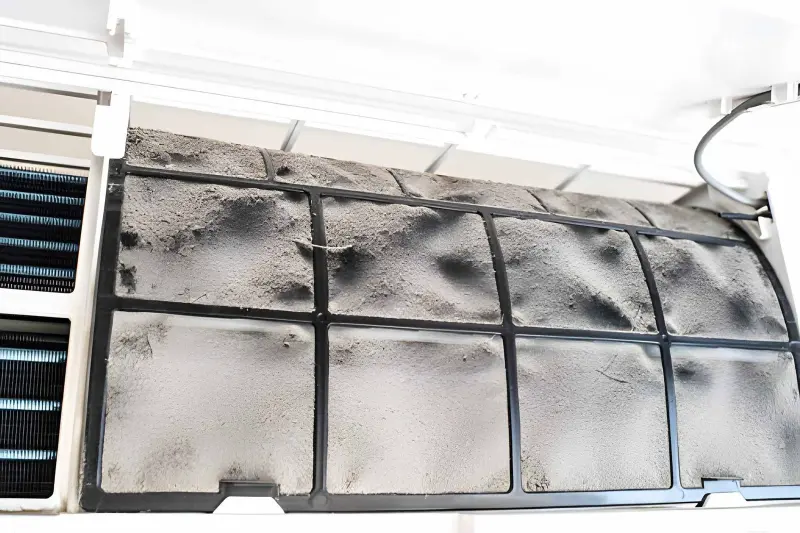
The first time I witnessed a serious sandstorm here, I was shocked. Not just by the sheer volume of dust in the air—though that was staggering—but by what it did to the AC systems I inspected the following week. I opened up a coil that had been running throughout the storm, and it looked like something had sprayed it with a fine layer of concrete dust. The fins were so clogged that air could barely pass through.
That moment made me understand something fundamental: Dubai’s AC challenges aren’t just about maintenance habits or usage patterns. They’re about the environment itself. Your AC system is fighting a battle against conditions that most of the world doesn’t experience.
What Makes Dubai’s Dust Different
Most people think dust is dust. It’s not.
Household dust—pet hair, skin cells, pollen from indoor plants—is one thing. It’s large, relatively inert, and filters catch it effectively.
Desert dust is entirely different. It’s microscopic. Fine. It travels in the air like smoke. And during sandstorms, it’s everywhere.
Dubai sits on the edge of one of the world’s largest deserts. The Arabian Desert doesn’t just create dust occasionally—it creates dust constantly. On calm days, you notice it settling on your car or windowsill. On sandstorm days, the air turns orange, visibility drops to meters, and the amount of particulate matter in the atmosphere exceeds what most air quality monitoring systems are designed to measure.
Here’s what makes this significant for your AC: that dust doesn’t just stay outside. It enters your home through every crack, every opening, every ventilation point. Your AC is the primary pathway. And once it’s inside your system, it causes damage that grows over time.
The Coil: Where Most Damage Happens
If you want to understand how dust damages your AC, you need to understand the evaporator coil.
The coil is a network of thin metal fins and tubes carrying cold refrigerant. Warm air from your room passes over it. The fins have a huge surface area—designed to maximize contact between air and cold metal. That contact is what makes cooling happen.
But here’s the vulnerability: those fins are thin, and they’re spaced closely together. The gaps between them are measured in millimeters. They’re designed for air to flow through them easily.
Desert dust particles are microscopic—often just a few microns in diameter. When you circulate dusty air through those tight fin spaces repeatedly, the particles begin to settle and accumulate. A few here, a few there. Over weeks and months, that accumulation becomes substantial.
What starts as an invisible layer of dust becomes a clogged coil.
Let me describe what I’ve seen. I opened a coil in a Dubai Marina apartment last month that hadn’t been cleaned in three years. The dust buildup was so dense that it had actually changed color—it had turned from light gray to dark gray, almost brown, from compression and oxidation over time. When I used compressed air to try to dislodge it, dust clouds filled the room. The owner was shocked. They’d had no idea.
That buildup didn’t happen because they were careless. It happened because they lived in Dubai, ran their AC continuously, and nobody had explained that desert dust damage requires more frequent attention than standard maintenance.
How Dust Clogs a Coil Step by Step
Understanding the progression helps explain why coil cleaning matters.
Week 1–4: The Invisible Stage
Fine dust particles begin settling on coil fins. The buildup is so minimal that you don’t notice anything. Your AC cools normally. No symptoms.
Month 2–3: Airflow Starts Declining
The dust layer thickens. It’s still not visible to the eye, but your AC has to work harder to push air through the clogged fins. You might notice the room takes slightly longer to cool, or the airflow feels a bit weaker. Most people attribute this to the heat and don’t think twice.
Month 4–6: Efficiency Drops Measurably
The dust layer is now thick enough to noticeably restrict airflow. Your AC runs longer to achieve the same cooling. Your electricity bill creeps up. If you have a smart AC unit that displays power consumption, you’d see it increasing.
Month 8–12: Secondary Problems Emerge
Here’s where it gets serious. A clogged coil can’t remove moisture from the air efficiently. Water condenses on the coil, but it can’t drain properly because dust is blocking the drainage paths. Moisture pools. In Dubai’s heat and humidity, mold begins to grow on the dust-covered coil. Bacteria follow. Now you’re not just dealing with dust—you’re dealing with biological contamination.
Month 12+: System Strain and Odor
Your AC is working at reduced efficiency. It’s generating odors (mold and bacteria). Your energy consumption is significantly higher. The system is under stress. If you’re unlucky, the compressor can fail prematurely from overwork.
This entire progression can happen without you realizing it’s occurring. You’re not ignoring maintenance—you’re just unaware that Dubai’s environment requires different maintenance thinking.
Sandstorms Accelerate Everything
Now consider what a sandstorm does.
A typical Dubai sandstorm lasts a few hours, but it can dump what amounts to weeks’ worth of dust accumulation into the air. If your AC is running during the storm—and most people’s are, because they want to stay cool while the outside air is literally orange—you’re pulling massive volumes of dust into your system.
I’ve measured the dust load in AC systems immediately following a significant sandstorm. The difference is striking. It’s like comparing a lightly used filter to one that’s been saturated with debris.
Some people ask: “Shouldn’t I turn off my AC during sandstorms?”
The answer is complicated. Yes, you’re pulling in more dust. But sealing your home without AC during a 45-degree Dubai sandstorm isn’t practical or safe. Most people run their AC on recirculation mode during storms—pulling air from inside the home rather than drawing from outside. This helps, but it’s not always foolproof if your system has gaps or if external dust still finds its way in.
The practical reality: sandstorms accelerate coil clogging. If you have a coil that would normally clog over 12 months, a series of sandstorms can compress that timeline significantly.
Coastal Exposure Adds Another Layer
If you’re in or near Dubai Marina, Jumeirah, or other coastal areas, you’re dealing with something beyond desert dust: salt air.
Coastal salt air corrodes metal. It’s more aggressive than desert dust. The evaporator coil is made of aluminum and copper—both metals that oxidize and degrade when exposed to salt spray, even indirectly.
A coil in a Marina apartment doesn’t just accumulate dust—it also experiences gradual corrosion. This makes the fins more brittle and more susceptible to damage if aggressive cleaning methods are used. It also means that dust accumulation can lead to localized corrosion and potential small leaks over time.
I’ve seen coils in coastal properties develop pinhole leaks after several years of poor maintenance. The combination of dust clogging and salt air corrosion created the conditions for failure.
Construction Dust: The Hidden Accelerator
Dubai is constantly changing. New buildings rise, existing structures get renovated, infrastructure expands. Construction generates dust—lots of it.
If you live near an active construction site, your AC faces additional stress. Construction dust is coarser and heavier than desert dust, but it’s also more substantial in volume. When construction is happening nearby, dust settles on everything, including entering your home’s ventilation.
Apartments in Downtown Dubai, Business Bay, Dubai Marina, and JVC—all areas with ongoing construction—experience faster coil contamination than properties in established, quieter areas.
I had a client in Downtown Dubai whose AC needed coil cleaning every 6 months instead of the typical 12. Why? Three construction sites within 500 meters of their building. Their AC filter was clogging within 2 months instead of 3, and their coil was accumulating dust at nearly double the normal rate.
The Moisture Problem: Dust + Humidity = Serious Issues
Here’s where the interaction between dust and Dubai’s climate becomes critical.
Dust on a coil is one problem. But when you combine dust accumulation with Dubai’s humidity, you get a compounded issue.
Dust particles on a coil create a barrier that traps moisture. The coil can’t dry out properly. Water that would normally drain begins pooling in microscopic pockets created by the dust layer.
In that trapped moisture, mold spores germinate. Bacteria colonize. What was a dust problem becomes a biological problem.
I’ve opened coils in Dubai apartments where the dust and mold combination had essentially created a organic paste coating the fins. The smell was intense. The health implications were concerning—these homes were circulating air loaded with mold spores and bacteria.
And here’s the thing: a homeowner wouldn’t necessarily realize this was happening. They might notice a musty smell, but they wouldn’t understand that it originated from a dust-covered coil creating an environment for mold growth.
Why Professional Coil Cleaning is Different from Filter Changes
At this point, you might be thinking: “Doesn’t changing my filter more often prevent this?”
It helps, but it’s not sufficient.
A filter catches particles before they enter the system. But in Dubai, with the dust load we’re discussing, some particles inevitably make it past the filter. They’re too small, too numerous, or they bypass the filter through seal gaps or other paths.
Once those particles are inside the system and on the coil, changing the filter won’t remove them. The filter can’t reach the coil. It can’t dislodge accumulated dust from the metal fins.
Professional coil cleaning involves:
- Accessing the coil directly
- Using specialized tools to dislodge and remove dust buildup
- In some cases, gentle chemical treatment to dissolve stubborn deposits
- Restoring proper drainage paths
- Verifying that airflow has been restored
After cleaning, the coil functions at full efficiency again. Your AC cools faster, uses less energy, and moisture drains properly—inhibiting mold growth naturally.
How Often Should You Clean Your Coil in Dubai?
This is where Dubai reality diverges from standard AC maintenance schedules.
In temperate climates, coil cleaning might be recommended every 3–5 years.
In Dubai, I’d recommend:
- Standard residential areas: Every 12 months
- Coastal properties (Marina, Jumeirah, etc.): Every 8–12 months
- Properties near active construction: Every 6–9 months
- Heavy AC usage properties (offices, hotels): Every 6 months
These aren’t arbitrary numbers. They’re based on observable patterns of coil contamination in Dubai properties. If you skip coil cleaning and go 2–3 years, you’re not just delaying maintenance—you’re allowing damage to accumulate.
The energy waste alone justifies annual cleaning. A clogged coil can increase AC energy consumption by 20–30%. If your annual AC costs are AED 3,000–4,000, a clogged coil is costing you AED 600–1,200 extra per year in wasted energy.
One professional coil cleaning costs far less than a year of elevated energy consumption.
Prevention: You Can’t Stop the Dust, But You Can Manage It
I’m realistic about this: you can’t prevent dust from entering your home in Dubai. Sandstorms happen. Desert dust is part of living here.
But you can minimize the damage:
Use quality filters and change them on schedule. In Dubai, every 2–3 months is appropriate. Don’t stretch to 6 months and definitely not a year. The better the filter, the more dust you catch before it enters the system.
Run your AC on recirculation during sandstorms. Instead of pulling air from outside, your system recirculates indoor air. Yes, your home will be a bit warmer, but you’re avoiding pulling massive dust loads into your coils.
Maintain realistic expectations about cleanliness. In Dubai, “clean” for an AC system is a relative term. You’re managing contamination, not eliminating it. Annual professional cleaning is standard maintenance, not excessive.
Monitor your system. If you notice airflow weakening, or if your energy bills are climbing even though you’re using your AC the same amount, it’s likely time for coil cleaning.
Schedule cleaning before high-season. Clean your coils in April, before the intense summer cooling begins. That way, your system faces the busiest months with a clean coil and full efficiency.
Expert Observation: What the Data Shows
Over years of managing AC systems in Dubai, a clear pattern emerges: properties that receive annual professional coil cleaning maintain consistent energy consumption and cooling performance. Their systems last longer. They experience fewer failures.
Properties that skip professional coil cleaning show declining efficiency, accelerating energy costs, and a higher rate of system failures—particularly compressor issues that are expensive to repair.
The difference isn’t huge in year one or two. But by year three or four, the gap is dramatic. A system that’s been professionally maintained looks brand new inside. A system that’s been neglected shows significant contamination and wear.
This isn’t hidden in sophisticated diagnostics. When I open a clogged coil versus a maintained coil, the difference is visually obvious. The maintained coil is shiny, the fins are clear, air flows freely. The neglected coil is gray with dust, the fins are partially obscured, and touching it feels like you’re touching a sponge that’s absorbed years of desert air.
Frequently Asked Questions
Q: Is the dust from sandstorms the main reason my coil gets clogged?
A: Sandstorms accelerate the process, but continuous desert dust exposure is the primary driver. Even on clear days, dust is settling on your coil. Sandstorms just compress weeks of accumulation into hours.
Q: Should I close my windows during sandstorms to prevent dust entering my AC?
A: Closing windows helps, but dust enters through ventilation systems, not just open windows. Using recirculation mode on your AC (drawing air from inside rather than outside) is more effective.
Q: Can I clean my coil myself?
A: Not safely. The coil fins are delicate. Aggressive cleaning or incorrect tools can damage them. Professionals use specialized equipment and techniques that remove dust without harming the coil.
Q: How do I know if my coil is clogged?
A: Weak airflow, slower cooling, increasing energy bills, and musty smells are all signs. But professional inspection is the only way to know for certain.
Q: Does salt air from the coast actually damage coils?
A: Yes. Salt air accelerates oxidation and corrosion of aluminum and copper coils. Coastal properties need more frequent maintenance than inland properties.
Q: Will my energy bill actually decrease after coil cleaning?
A: Usually, yes. A clogged coil forces your AC to work harder. After cleaning, efficiency improves noticeably. Most people see 10–20% reduction in AC energy consumption.
Q: Is there anything I can do to slow coil contamination?
A: Quality filters changed every 2–3 months help significantly. Using recirculation mode during construction periods helps. But in Dubai, some contamination is inevitable—professional cleaning is the solution.
Q: Why is coil cleaning expensive compared to other maintenance?
A: Because it requires accessing internal system components, using specialized equipment, and technical expertise. It’s not a quick filter change—it’s a detailed service that takes 2–4 hours.